
Train for Life with Functional Fitness Workouts at AFAC Gym
Many people head to the gym with goals like building muscle, losing weight, or improving endurance. While those are worthwhile objectives, there’s another type of training that can make an even bigger impact on your everyday life: functional fitness.
Functional fitness is designed to help your body move better during the activities you perform outside the gym. Whether you’re lifting a heavy laundry basket, carrying groceries from the car, climbing a flight of stairs, gardening on the weekend, or playing with your children or grandchildren, functional exercises prepare your body for real-world movement.
One of the biggest misconceptions about fitness is that being strong automatically means your body is prepared for everyday challenges. Someone may be capable of lifting impressive amounts of weight in the gym yet still experience discomfort or injury while moving furniture, reaching into the back seat of the car, or bending over to tie their shoes. That’s because many daily movements require coordination, balance, flexibility, stability, and core control, not simply strength.
Functional fitness bridges that gap by teaching your muscles and joints to work together as one coordinated system. Instead of isolating a single muscle, these workouts mimic the way your body naturally moves throughout the day.
At AFAC gym in Thornton, Colorado, we believe fitness should improve every aspect of your life, not just your performance during a workout. Whether you’re new to exercise, training for a sport, recovering after an extended break, or simply looking to stay active as you age, incorporating functional fitness into your routine can help you move with greater confidence while reducing your risk of injury.
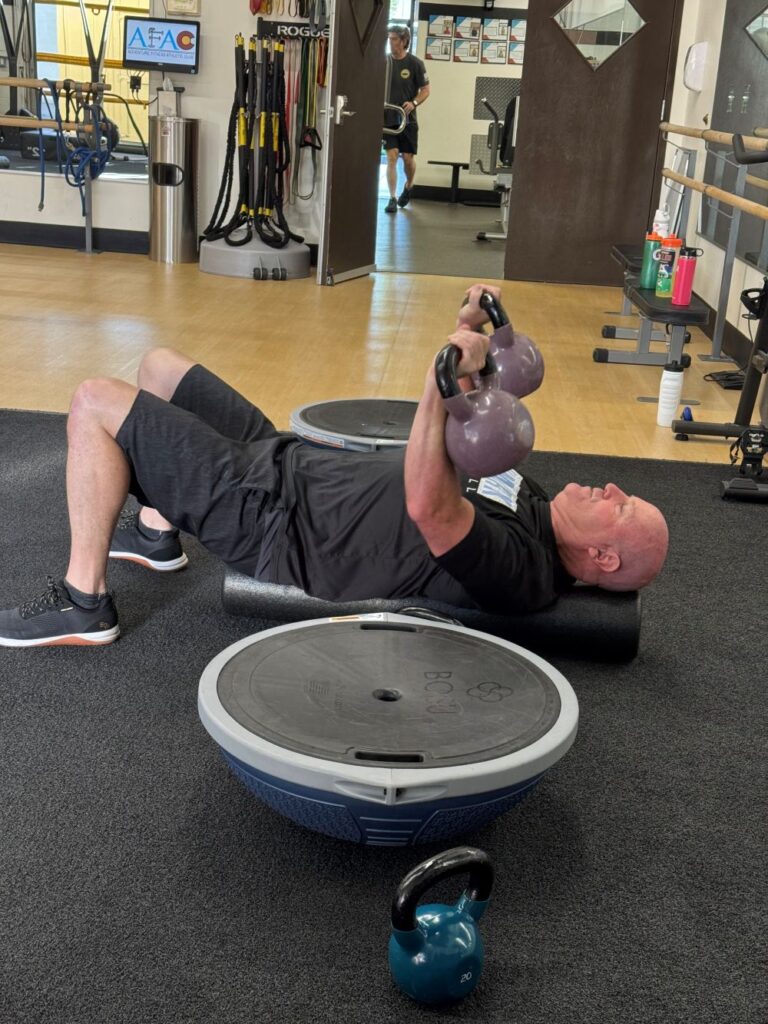

What Is Functional Fitness?
Functional fitness is a style of exercise that focuses on preparing your body for real-life movement. Rather than emphasizing how much weight you can lift on a machine or how large a particular muscle becomes, functional training develops strength through natural movement patterns that translate directly into everyday activities.
Think about everything your body does during an average day. You squat down to pick something up, reach overhead to place items on a shelf, carry groceries, push open heavy doors, climb stairs, twist while unloading the dishwasher, or kneel to play with a child or pet. These seemingly simple tasks actually require multiple muscles and joints to work together.
Functional fitness trains your body to perform those movements more efficiently.
Instead of asking, “How much can I bench press?” functional fitness asks questions like:
-
- Can I safely lift a heavy box from the floor?
-
- Can I maintain my balance while walking on uneven ground?
-
- Can I carry luggage through an airport without straining my back?
-
- Can I get up from the floor comfortably?
-
- Can I stay active as I get older without losing my independence?
Those are the types of abilities that functional training is designed to improve.
Unlike many traditional weight machines that restrict movement into a fixed path, functional exercises encourage your body to stabilize itself through multiple planes of motion. Your core, hips, shoulders, legs, and back all learn to work together instead of independently.
For example, imagine someone who regularly performs heavy leg presses on a machine. Their leg muscles may become quite strong, but if they’ve never practiced squatting, hinging, balancing, or lifting objects from the floor, they may still struggle with common physical tasks outside the gym.
Similarly, someone may have impressive arm strength from bicep curls but experience shoulder or back pain while lifting a toddler or placing luggage into an overhead compartment because those activities involve much more than elbow flexion.
Functional fitness fills those gaps by emphasizing movement over individual muscles.
A Training Style Rooted in Rehabilitation
Interestingly, functional fitness didn’t begin as a mainstream workout trend.
Its roots lie in physical rehabilitation.
For decades, physical therapists, occupational therapists, and rehabilitation specialists have used movement-based exercises to help patients recover after surgeries, injuries, illnesses, or neurological conditions. Rather than simply making a muscle stronger, rehabilitation professionals focused on restoring the movements people needed to live independently.
If someone underwent knee surgery, their rehabilitation wasn’t centered on making their quadriceps look larger. Instead, therapy focused on helping them climb stairs, stand from a chair, kneel, walk confidently, and return to work or recreational activities safely.
Likewise, someone recovering from a shoulder injury might practice reaching overhead, carrying light objects, or lifting groceries because those are the movements they perform every day.
Modern functional fitness has borrowed many of these principles and adapted them for healthy individuals looking to improve overall movement quality, athletic performance, and longevity.
Functional Fitness Is Different for Everyone
One of the greatest strengths of functional training is that it isn’t one-size-fits-all.
A firefighter, office worker, retired adult, tennis player, parent of young children, and construction worker all place different demands on their bodies. Their workouts should reflect those differences.
Someone whose job involves frequent lifting may benefit from strengthening their hips, back, and core.
An avid golfer may focus more on rotational strength and mobility.
Older adults may prioritize balance, stability, and getting up from the floor safely.
Parents might emphasize carrying, squatting, and reaching while reducing stress on their backs.
Because functional fitness can be adapted to individual lifestyles and goals, it remains one of the most versatile forms of exercise available.
What Are the Components of Functional Fitness?
While functional fitness may look different from person to person, every program is built around several foundational physical abilities. Together, these components help your body move efficiently while improving both performance and injury resistance.
Strength
Strength remains one of the cornerstones of functional fitness, but it’s applied differently than in traditional bodybuilding.
Rather than isolating one muscle at a time, functional strength develops the body’s ability to produce force while multiple muscle groups work together.
Exercises like squats, deadlifts, push-ups, carries, rows, and lunges strengthen muscles in coordinated patterns that closely resemble daily activities.
This type of strength often translates more naturally into lifting boxes, carrying children, moving furniture, or performing physically demanding work.
Balance and Coordination
Good balance isn’t just important for athletes or older adults.
Every step you take requires your body to make hundreds of tiny adjustments to keep you upright. Functional exercises challenge your stability by incorporating unilateral movements, changing directions, and encouraging greater body awareness.
Improving coordination allows muscles to communicate more effectively, resulting in smoother, more efficient movement.
Better balance can also reduce the likelihood of slips, trips, and falls while increasing confidence during recreational activities like hiking, skiing, pickleball, or tennis.
Mobility
Mobility refers to your ability to actively move your joints through their full range of motion while maintaining control.
Without adequate mobility, even simple tasks become more difficult.
Limited shoulder mobility can make reaching overhead uncomfortable.
Restricted hip mobility can affect your squat mechanics.
Stiff ankles may alter your walking pattern and contribute to knee discomfort.
Functional fitness includes movements that improve joint mobility while teaching your body to use those new movement ranges effectively.
Flexibility
Although flexibility and mobility are often used interchangeably, they are not the same.
Flexibility refers to how much a muscle can lengthen.
Mobility combines flexibility with strength and control.
Functional training often incorporates dynamic stretches and controlled movement patterns that improve both qualities simultaneously, helping your body move more freely while maintaining stability.
Power
Power is your body’s ability to generate force quickly.
While elite athletes rely heavily on power for sprinting or jumping, everyday life also requires bursts of explosive movement.
Standing up from a chair, catching yourself during a stumble, stepping over an obstacle, or quickly changing direction all require power.
Functional exercises can safely improve this quality through controlled movements appropriate for your fitness level.
Core Stability
Contrary to popular belief, your core is much more than your abdominal muscles.
Your core includes numerous muscles surrounding your spine, pelvis, diaphragm, and hips.
These muscles stabilize your body during nearly every movement you perform.
Whether you’re carrying groceries, reaching overhead, pushing a lawn mower, or simply walking, your core acts as the foundation that transfers force between your upper and lower body.
Functional fitness places significant emphasis on developing a strong, stable core because nearly every movement depends upon it.
Functional Movement Patterns
Instead of thinking in terms of individual exercises, functional fitness focuses on movement patterns you’ll use throughout life.
These commonly include:
-
- Squatting
-
- Hinging at the hips
-
- Pulling
-
- Rotating
-
- Carrying
-
- Walking
-
- Reaching
-
- Standing up and sitting down
By practicing these movements under controlled conditions, your body becomes more efficient at performing them naturally throughout the day.
How Does Functional Fitness Work?
Functional fitness works by teaching your muscles, joints, and nervous system to operate together more effectively.
Every movement your body performs begins in the brain.
When you decide to pick up a heavy object, your brain rapidly communicates with muscles throughout your body, coordinating countless contractions and adjustments to complete the task safely.
The more often you practice efficient movement patterns, the more refined these communication pathways become.
This process is known as neuromuscular adaptation.
Instead of relying on isolated muscle strength alone, your body learns how to distribute work across multiple muscle groups.
For example, a properly performed squat recruits your ankles, knees, hips, glutes, quadriceps, hamstrings, core, and upper back simultaneously.
A farmer’s carry challenges your grip strength, shoulder stability, posture, core, and lower body all at once.
A walking lunge develops strength while also improving balance, coordination, and hip mobility.
These exercises create a more integrated body that performs better both inside and outside the gym.
Better Movement Through Practice
Movement quality improves through repetition.
As your body repeatedly practices safe movement patterns, those movements become more automatic.
Eventually, tasks like lifting groceries, climbing stairs, gardening, or carrying luggage require less effort because your muscles have already rehearsed similar movements during training.
Supporting Healthy Aging
One of the greatest advantages of functional fitness is its long-term value.
As we age, it’s common to lose muscle mass, balance, reaction time, and mobility. These changes can gradually make everyday activities more difficult.
Functional training helps preserve many of these abilities by continually challenging the body to maintain strength, coordination, flexibility, and stability.
Improved balance is particularly important because falls remain one of the leading causes of injury among older adults. Even beginning functional fitness during young or middle adulthood may help establish movement habits that support healthier aging decades later.
Perhaps most importantly, functional fitness isn’t reserved for elite athletes or highly conditioned individuals.
The principles can be scaled for nearly every age, fitness level, or experience.
Whether someone starts with bodyweight exercises, resistance bands, kettlebells, or barbells, the goal remains the same: helping the body move more confidently, efficiently, and safely throughout life.
What Are the Benefits of Functional Fitness?
Functional fitness offers benefits that extend far beyond the gym floor. Rather than improving just one aspect of physical performance, it develops multiple qualities simultaneously, making everyday movement easier while supporting long-term health.
Everyday Tasks Become Easier
Perhaps the most noticeable benefit is how everyday activities begin to feel less demanding.
Simple actions like climbing stairs, carrying groceries, lifting children, mowing the lawn, or loading luggage become easier because your body has practiced similar movement patterns during workouts.
Instead of feeling exhausted by routine physical tasks, you’ll often notice greater energy throughout the day.
Improved Balance and Stability
Better balance doesn’t just reduce the risk of falls. It also improves confidence.
Whether you’re walking on uneven trails, navigating crowded sidewalks, or participating in recreational sports, improved stability allows you to move more comfortably and react more effectively to unexpected changes in terrain or direction.
Increased Mobility and Flexibility
Functional training encourages joints to move through healthy ranges of motion while strengthening muscles that support those movements.
Over time, many people notice they can squat deeper, reach farther, bend more comfortably, and move with less stiffness.
Better Posture
Because functional exercises strengthen the muscles responsible for spinal alignment and core stability, they often promote healthier posture.
Improved posture may reduce unnecessary strain on the neck, shoulders, and lower back while making movement feel more natural.
Reduced Injury Risk
No workout can eliminate injuries entirely, but preparing your body for real-world movement helps improve resilience.
Strong stabilizing muscles, better movement mechanics, improved balance, and greater mobility all work together to reduce unnecessary stress on joints and connective tissues during everyday activities.
Enhanced Athletic Performance
Functional fitness isn’t only for daily life. It can also benefit recreational athletes.
Golfers, runners, cyclists, tennis players, skiers, and weekend warriors often discover improved coordination, strength, agility, and movement efficiency that carries over into their favorite activities.
Support for Long-Term Health
Maintaining muscle mass, mobility, and physical independence becomes increasingly important with age.
Functional fitness helps preserve these qualities while encouraging lifelong movement, making it an excellent addition to nearly any exercise program.
Perhaps the greatest benefit is that functional fitness isn’t about becoming the strongest person in the room. It’s about becoming more capable in every aspect of your life. When your workouts help you move better, feel stronger, and enjoy everyday activities with greater confidence, fitness becomes an investment in your quality of life.
Should I Incorporate Functional Fitness into My Gym Routine?
For most people, the answer is yes.
Functional fitness isn’t reserved for athletes, fitness enthusiasts, or people recovering from injuries. It’s a practical style of training that can benefit almost anyone because everyone relies on movement throughout the day.
Adding functional training to your gym routine can help you perform those activities with greater confidence and less discomfort.
That doesn’t mean you need to completely abandon your current workout program. In fact, functional fitness works exceptionally well alongside traditional strength training, cardiovascular exercise, and recreational sports. Even dedicating two or three workouts each week to functional movements can significantly improve how your body moves.
Start Where You Are
One of the greatest advantages of functional fitness is that it can be adapted to virtually any fitness level.
If you’re brand new to exercise, bodyweight movements like squats, step-ups, glute bridges, and modified push-ups provide an excellent foundation. These exercises teach proper movement patterns before resistance is added.
As your strength, balance, and confidence improve, you can gradually introduce kettlebells, dumbbells, resistance bands, medicine balls, or barbells to increase the challenge.
Progressing slowly allows your muscles, joints, and connective tissues to adapt while reducing the risk of overuse injuries.
Personalization Matters
Unlike cookie-cutter workout programs, functional fitness is most effective when it’s tailored to your individual goals and lifestyle.
For example:
-
- An office worker who spends long hours sitting may benefit from exercises that strengthen the hips, core, and upper back while improving posture and mobility.
-
- A parent with young children might focus on safe lifting mechanics, carrying strength, and rotational stability.
-
- A golfer could prioritize core strength, balance, and rotational power.
-
- A runner may benefit from single-leg stability exercises and hip strengthening.
-
- Older adults often place greater emphasis on balance, coordination, mobility, and maintaining independence.
Because everyone’s body and daily demands are different, the best functional fitness programs address individual weaknesses while building upon existing strengths.
Work with a Qualified Fitness Professional
If you’re new to functional training or returning after an injury, it can be extremely helpful to work with an experienced fitness coach or certified personal trainer.
Proper technique is essential. Exercises like squats, hinges, lunges, carries, and presses may look simple, but performing them with correct mechanics helps maximize results while minimizing unnecessary stress on the body.
At AFAC gym, our knowledgeable trainers can evaluate your current movement patterns, identify limitations, and build a program that safely progresses as your abilities improve.
Who Benefits Most from Functional Fitness?
Although functional fitness can benefit nearly everyone, it’s particularly valuable if you:
-
- Want to move more comfortably during everyday activities
-
- Spend much of your day sitting at a desk
-
- Are returning to exercise after an extended break
-
- Want to reduce your risk of injury
-
- Are interested in improving athletic performance
-
- Hope to stay active and independent as you age
-
- Experience occasional stiffness, poor balance, or reduced mobility
The beauty of functional training is that it meets you where you are. Whether you’re 25 or 75, just beginning your fitness journey or looking to complement years of strength training, functional exercises can be adjusted to fit your current ability level.
How Does Functional Fitness Differ from Other Workouts?
Most workout programs help improve your health in some way, but they don’t all train the body for the same purpose.
Some routines are designed primarily to increase muscle size. Others focus on building maximum strength or improving cardiovascular endurance. Functional fitness has a different objective altogether.
Its goal is to help you move better, not only inside the gym but throughout every aspect of your daily life.
Rather than isolating muscles, functional training develops coordinated movement patterns that involve multiple joints and muscle groups working together.
This approach doesn’t necessarily replace traditional exercise methods. Instead, it fills in the gaps that many conventional training programs leave behind.
Let’s compare functional fitness to some of the most common workout styles.
Functional Fitness vs. Traditional Weight Training
Traditional resistance training often relies heavily on machines that guide your body through a predetermined path of motion.
These machines can be excellent tools for beginners, rehabilitation programs, or isolating specific muscles. They’re also effective for increasing strength in targeted muscle groups.
However, they typically stabilize your body for you.
When you’re seated on a leg extension machine or supported by the pads of a chest press machine, many of the smaller stabilizing muscles throughout your body remain relatively inactive.
Functional fitness takes the opposite approach.
Instead of relying on external support, it teaches your body to create its own stability while moving naturally through space.
For example, compare these two exercises:
Seated Row Machine
During a seated row, your chest rests against a pad while the machine controls the movement pattern. The exercise primarily strengthens the muscles of the upper back and arms.
Bent-Over Row
A bent-over row using free weights works many of the same muscles, but it also requires your core, glutes, hamstrings, hips, lower back, shoulders, and stabilizing muscles to work together to maintain proper posture throughout the movement.
That closely resembles many real-life activities, such as lifting boxes, pulling heavy objects, unloading groceries, or working in the yard.
Traditional Weight Training Characteristics
Traditional machine-based workouts often involve:
-
- Isolating one muscle group at a time
-
- Fixed movement paths
-
- Limited balance demands
-
- Less core activation
-
- Minimal coordination requirements
-
- Reduced emphasis on real-world movement patterns
Functional Fitness Characteristics
Functional workouts generally emphasize:
-
- Multiple muscle groups working together
-
- Standing exercises
-
- Free movement through multiple planes of motion
-
- Core stability
-
- Balance and coordination
-
- Everyday movement patterns
-
- Greater overall body awareness
Both styles have value.
Machine exercises remain useful for rehabilitation, muscle building, or strengthening specific weak areas. Functional training simply provides additional benefits by teaching your body how to apply that strength during everyday life.
Functional Fitness vs. HIIT
Functional exercises pair exceptionally well with High-Intensity Interval Training (HIIT).
Movements like kettlebell swings, walking lunges, step-ups, medicine ball slams, and farmer’s carries elevate the heart rate while simultaneously building strength and improving coordination.
This combination provides an efficient workout that develops both muscular endurance and cardiovascular fitness.
Functional Fitness vs. CrossFit
Because both training styles include exercises like squats, lunges, deadlifts, presses, and carries, functional fitness is often confused with CrossFit.
While they certainly share similarities, they’re not the same thing.
Functional fitness is a broad training philosophy centered around improving movement quality, mobility, stability, and practical strength.
CrossFit is a branded fitness methodology built around constantly varied workouts that combine strength training, gymnastics, and cardiovascular conditioning, often performed at relatively high intensity.
The Main Difference Is the Goal
Functional fitness asks:
“How can I move better?”
CrossFit often asks:
“How can I complete this workout more efficiently or improve my performance?”
Neither approach is inherently better.
They simply prioritize different outcomes.
Intensity
One of the biggest distinctions is workout intensity.
CrossFit workouts frequently involve timed circuits, high repetitions, Olympic lifting, rowing, running, and bodyweight exercises performed with minimal rest.
Functional fitness places greater emphasis on mastering movement before increasing speed or intensity.
A functional training session may spend considerable time improving balance, mobility, posture, or movement mechanics before progressing to heavier loads.
Accessibility
Because functional fitness is highly adaptable, it’s often more approachable for beginners, older adults, or individuals recovering from injuries.
Exercises can easily be modified to accommodate different fitness levels.
CrossFit can also be scaled, but its workouts often appeal to individuals seeking competitive, high-intensity training environments.
Functional Fitness vs. Bodybuilding
Bodybuilding and functional fitness may both involve lifting weights, but they pursue very different goals.
Bodybuilding is centered on developing muscle size, symmetry, and definition.
Training programs are carefully designed to maximize muscular growth while creating balanced aesthetics for competition or personal appearance goals.
Exercises often isolate individual muscles to stimulate growth from multiple angles.
Functional fitness, on the other hand, focuses less on how muscles look and more on how they perform.
The emphasis shifts from creating larger muscles to creating a body that moves efficiently, remains stable, and performs well during everyday activities.
Different Training Priorities
A bodybuilder may divide workouts into separate muscle groups:
-
- Back day
-
- Shoulder day
-
- Arm day
-
- Leg day
Functional fitness is more likely to organize workouts around movement patterns, such as:
-
- Squatting
-
- Pushing
-
- Pulling
-
- Hinging
-
- Carrying
-
- Rotating
-
- Crawling
-
- Balancing
This approach reflects how the body naturally moves throughout daily life.
Functional Strength vs. Muscle Size
Large muscles don’t always translate into efficient movement.
For example, someone may leg press several hundred pounds but struggle to maintain balance during a single-leg squat.
Likewise, an impressive bench press doesn’t automatically mean someone can safely lift a heavy object overhead or carry awkward loads across uneven terrain.
Functional fitness emphasizes usable strength, the kind that improves performance during everyday tasks.
Injury Prevention
Because functional training incorporates stabilizing muscles, mobility work, and movement quality, it often helps address muscular imbalances that can develop when certain muscle groups receive disproportionate attention.
That doesn’t mean bodybuilding causes injuries. Rather, adding functional exercises alongside traditional bodybuilding routines can create a more balanced, resilient body.
The Rise of Functional Bodybuilding
Interestingly, many strength coaches now blend the best aspects of both training philosophies.
This approach, often called functional bodybuilding, combines compound movements with targeted accessory work to improve strength, movement quality, muscular development, and athletic performance simultaneously.
For example, a workout might include barbell squats and pull-ups followed by single-leg stability exercises, rotational core work, and isolated shoulder strengthening.
This combination helps build both an impressive physique and a body that’s capable of handling the physical demands of everyday life.
Which Style Is Best?
The answer depends on your goals.
If your primary objective is maximizing muscle size and aesthetics, bodybuilding may be the best fit.
If you’re focused on improving sports performance, preventing injuries, moving better, and maintaining lifelong physical independence, functional fitness deserves a place in your routine.
Fortunately, these approaches don’t have to compete. Many gym members find that combining traditional strength training with functional movement exercises gives them the best of both worlds, building strength while ensuring that strength translates into everyday life.
Functional Fitness Training Exercises for Beginners
One of the biggest advantages of functional fitness is that you don’t need years of experience to get started. Many foundational movements use your own body weight and teach proper mechanics before additional resistance is introduced.
If you’re new to functional fitness, focus on mastering good form rather than lifting heavy weights. As your strength and confidence improve, you can gradually increase the challenge.
Here are some excellent beginner-friendly functional fitness exercises you’ll commonly see in the gym.
Box Step-Ups
Step-ups closely mimic one of the most common daily activities: climbing stairs. They strengthen the glutes, quadriceps, hamstrings, and calves while improving balance and coordination. They also help correct strength differences between your left and right legs.
Goblet Squats
Holding a dumbbell or kettlebell at chest level while performing a squat encourages proper posture and core engagement. Goblet squats develop lower-body strength while reinforcing one of the most important movement patterns you use every day: standing up and sitting down.
Romanian Deadlifts
This hip-hinge exercise teaches you how to safely bend forward while protecting your lower back. Romanian deadlifts strengthen the hamstrings, glutes, and lower back, making everyday lifting tasks safer and more efficient.
Dumbbell Bench Press
Unlike many chest machines, using dumbbells requires each arm to work independently while engaging stabilizing muscles throughout your shoulders and core. It improves pushing strength that carries over into everyday activities like pushing heavy doors, strollers, or lawn equipment.
Farmer’s Carry
Sometimes the simplest exercises are the most practical.
Grab a pair of dumbbells or kettlebells and simply walk while maintaining good posture.
Farmer’s carries strengthen your grip, shoulders, core, hips, and legs while improving overall stability. Think about carrying grocery bags, luggage, buckets, or sports equipment. This exercise directly prepares your body for those tasks.
Lunges and Reverse Lunges
Lunges develop lower-body strength while improving balance and coordination. Reverse lunges are often a great starting point because they place slightly less stress on the knees while still strengthening the hips and legs.
Push-Ups (or Modified Push-Ups)
Push-ups are one of the best total-body exercises available. They strengthen the chest, shoulders, triceps, and core while reinforcing proper body control. Beginners can perform push-ups against a wall, on an incline bench, or from the knees before progressing to standard push-ups.
The key for beginners isn’t performing dozens of repetitions, it’s learning to move well. Once proper movement becomes second nature, increasing resistance becomes much safer and more effective.
Functional Fitness Training Exercises for More Advanced Gym Members
Once you’ve established a solid foundation, functional training can become progressively more challenging. Adding resistance, increasing complexity, or introducing single-leg and rotational movements helps continue building strength, stability, and athletic performance.
Some excellent advanced functional exercises include:
Barbell Squats
The barbell squat is often considered one of the most effective total-body strength exercises. It builds powerful legs, hips, and core while reinforcing proper squatting mechanics.
Incline Chest Press
Whether performed with dumbbells or a barbell, the incline press strengthens the upper chest and shoulders while requiring greater stabilization than many machine-based exercises.
Walking Lunges
Walking lunges add movement to the traditional lunge, challenging balance, coordination, and lower-body endurance simultaneously.
Bent-Over Rows
Unlike seated row machines, bent-over rows require you to stabilize your spine, engage your core, and maintain proper hip positioning throughout the exercise.
Lunge with Bent-Over Row
Combining two functional movements into one exercise challenges multiple muscle groups at once while improving coordination between the upper and lower body.
Single-Leg Deadlifts
This exercise demands exceptional balance, hip stability, and core strength. Because many everyday movements occur while standing on one leg, even something as simple as climbing stairs, single-leg training provides tremendous real-world benefits.
Single-Leg Balance Exercises
Standing on one leg may sound easy until you try it.
Single-leg balance drills improve ankle stability, coordination, and proprioception, your body’s awareness of its position in space. These qualities become increasingly important for injury prevention and athletic performance.
Wall Squats
Wall squats develop muscular endurance throughout the lower body while encouraging proper posture and alignment.
Advanced exercises don’t necessarily require the heaviest weights in the gym. Instead, they often challenge your body’s ability to remain stable, coordinated, and efficient during increasingly complex movement patterns.
Functional Fitness Exercises for Seniors
Functional fitness becomes increasingly valuable as we age.
Maintaining strength, mobility, balance, and confidence allows older adults to remain active, independent, and engaged in the activities they enjoy.
The goal is to continue moving safely and comfortably throughout everyday life.
Here are several functional exercises that are particularly beneficial for seniors.
Sit-to-Stand
This simple exercise strengthens the muscles needed to safely stand up from a chair without using your hands. It’s one of the most practical functional movements older adults can practice.
Air Squats
Bodyweight squats improve lower-body strength while supporting mobility and balance. They closely mimic everyday movements like sitting down and standing back up.
Kettlebell Deadlifts
Using a light kettlebell teaches safe lifting mechanics while strengthening the hips, glutes, legs, and core.
Farmer’s Carry
Carrying moderate weight while walking strengthens grip strength, posture, and balance, skills used every day.
Forearm Planks
Planks strengthen the core without requiring excessive spinal movement. A stronger core supports better posture and improves overall stability.
Bear Crawls
When appropriate and modified to the individual’s abilities, bear crawls improve coordination, shoulder stability, core strength, and total-body control.
As with any exercise program, seniors should work within their own abilities and consult a qualified healthcare provider or fitness professional if they have medical concerns or a history of injury. Exercises can always be modified to meet individual needs while still providing meaningful benefits.
Can Functional Fitness Reduce Pain?
Many people assume pain automatically means they should stop moving.
In reality, appropriate movement is often one of the most effective ways to improve how the body functions.
That doesn’t mean exercising through severe pain or ignoring an injury. Rather, carefully selected movement patterns can help restore confidence, improve mobility, and strengthen the muscles that support healthy movement.
For individuals experiencing chronic aches or stiffness, certain movements may begin to feel intimidating. After all, if bending over once caused back pain, it’s understandable to become cautious about bending again.
Over time, avoiding those movements altogether can create a cycle of decreased activity, muscle weakness, reduced mobility, and even greater discomfort.
Functional fitness works to gently break that cycle.
By practicing safe movement patterns under controlled conditions, your body gradually learns that many everyday activities can be performed without fear. As strength, mobility, and coordination improve, everyday tasks often begin to feel less threatening and more comfortable.
Functional training also strengthens the muscles surrounding major joints, helping distribute forces more evenly throughout the body instead of placing excessive stress on one area.
While functional fitness isn’t a cure for every type of pain, it can become an important part of a long-term strategy for improving movement quality and maintaining an active lifestyle.
If you have chronic pain, recent injuries, or medical conditions, always consult your physician or physical therapist before beginning a new exercise program.
Exercise at AFAC Gym for the Life You Want to Live
By combining balance, mobility, coordination, flexibility, and total-body strength, functional training creates a foundation that supports every aspect of your health and wellness. It’s a style of exercise that grows with you, adapting to your goals and helping you stay active for years to come.
At AFAC gym, we’re committed to helping members build fitness that extends far beyond the walls of the gym. Our knowledgeable trainers can help you incorporate functional movements into your existing workout routine or create a personalized training plan designed around your lifestyle, experience level, and goals.
The strongest body isn’t always the one that lifts the most weight. It’s the one that’s prepared for whatever life brings next.
If you’re not a member yet, we hope you’ll visit AFAC gym today to speak to our team about our affordable memberships and personal trainers. AFAC gym is committed to supporting your health and wellness efforts, so you’ll see the results you’re working so hard for. That’s why we were voted the best gym in Thornton, Colorado, and have hundreds of 5-star reviews.
To learn more about our top-rated gym and our incredible array of strength training and cardio equipment — as well as our unique offerings and amenities like daily group classes, cryotherapy, InBody 770 assessments, hydro massage, personal trainers, and our rock climbing wall and cave — please contact us or visit for a personalized tour. Our team will be happy to help you. For more information and assistance, you can also contact our gym owner, Susan, at 720-849-0245 or susan@adventurefitness.club.