
Winning With Wall Balls at AFAC Gym
There’s something naturally satisfying about throwing a ball against a wall and catching it on the rebound. As kids, we might have done it for fun. In the gym, adding a weighted ball, a deep squat, and an explosive throw transforms that simple movement into a challenging full-body exercise.
Wall balls combine strength training, power, coordination, and cardiovascular conditioning in one continuous movement. You begin by holding a weighted wall ball near your chest and lowering into a squat. From there, you drive through your legs and hips to stand explosively while throwing the ball toward a target high on the wall. After catching the ball, you immediately transition into your next squat.
It sounds straightforward, but a few repetitions quickly demonstrate how much of the body is involved. Your quadriceps, hamstrings, and glutes power you out of the squat. Your core stabilizes your body and helps transfer force from your lower body to your upper body. Meanwhile, your chest, shoulders, and arms help guide the ball toward its target and control it on the way back down.
Because you repeat this sequence continuously, wall balls can also elevate your heart rate and challenge muscular endurance. That makes them useful whether you’re trying to develop explosive power, add variety to your workouts, improve functional fitness, or prepare for an event such as HYROX at AFAC gym in Thornton, Colorado.

How to Choose Wall Balls at the Gym
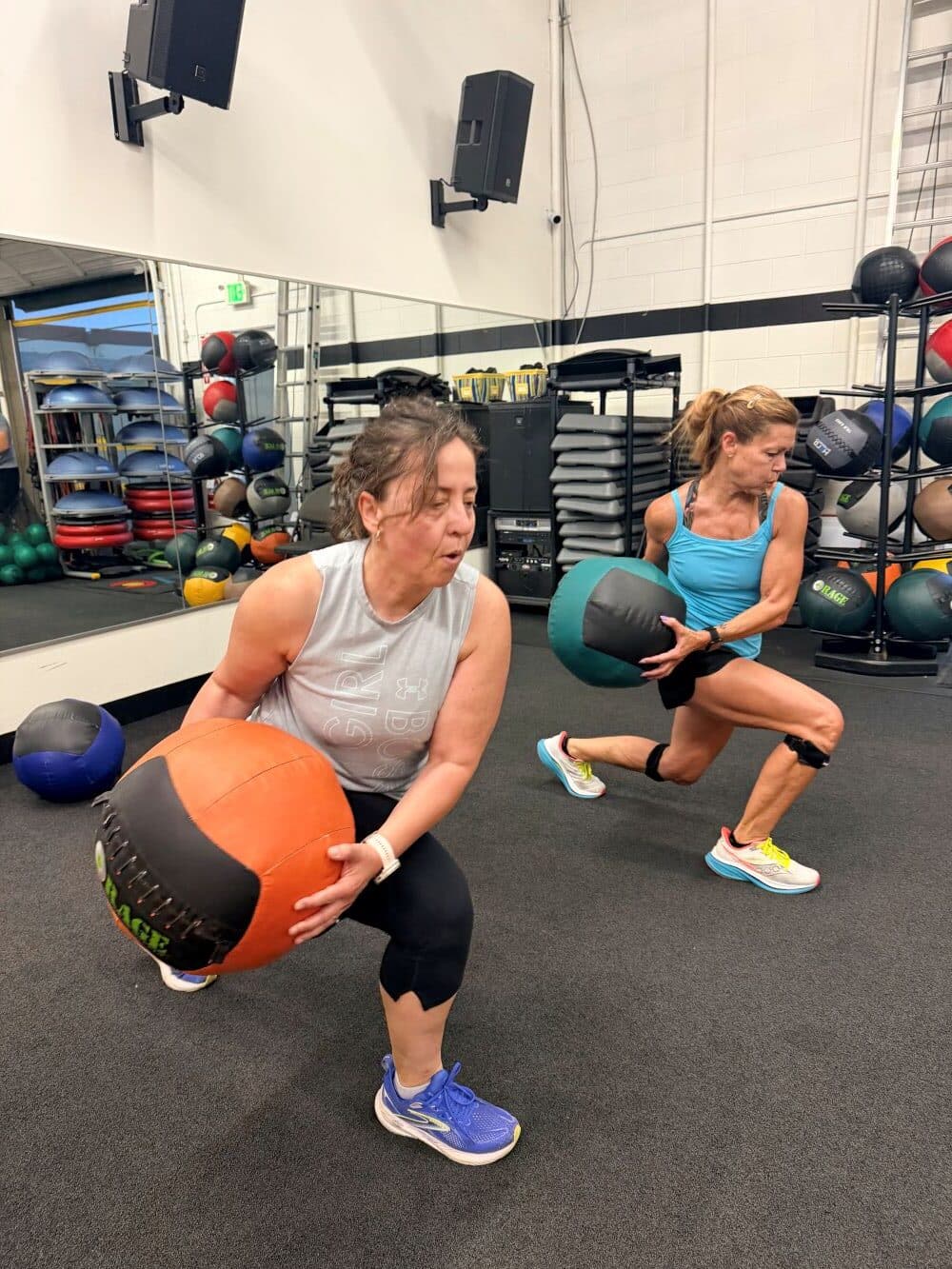
Traditional wall balls are large, padded weighted balls designed specifically for repeated throwing and catching. Many are approximately 14 inches in diameter, roughly the size of a large pizza, and have a synthetic leather or vinyl exterior. Unlike a hard medicine ball, their soft-shelled construction makes them more comfortable to catch against the chest during high-repetition workouts.
AFAC gym has wall balls available for members, so you can experiment with different weights to find an appropriate option for your workout.
Wall balls commonly range from around 4 to 30 pounds. If you’re learning the movement, a ball in the 6- to 8-pound range can be a reasonable starting point. Experienced exercisers may be comfortable beginning with 10 pounds or more.
Don’t choose a ball based on how impressive the number sounds. The appropriate weight is one you can control through the entire movement. You should be able to maintain good squat mechanics, generate enough force to reach your target, and safely catch the ball without losing your posture.
If your squat becomes shallower, your back begins rounding, or you have to rely almost entirely on your arms to get the ball high enough, consider dropping to a lighter ball. Master the movement first, then gradually increase resistance.
How to Do Wall Balls at the Gym
Wall balls require several movements to happen in sequence, so technique and timing are important. If you’ve never done them before, consider asking an AFAC gym personal trainer to demonstrate the exercise and evaluate your form. Anyone with an injury, medical condition, or physical limitation that could affect exercise should also consult an appropriate healthcare professional before adding a new high-intensity movement.
To perform a basic wall ball:
- Set your position. Stand approximately two feet from a tall, sturdy wall with your feet around shoulder-width apart. Hold the ball close to your chest with both hands and keep your elbows relatively close to your body.
- Lower into your squat. Push your hips down and back while bending your knees. Descend only as far as you can comfortably while maintaining control. Depending on your mobility and experience, your goal may be to bring your thighs roughly parallel with the floor.
- Drive upward. Push through your feet and rapidly extend your knees and hips. Think about generating the throw from your lower body rather than simply pressing the ball upward with your arms.
- Release the ball. As you approach full extension, use the momentum you’ve created to throw the ball toward a target on the wall, generally around eight to 12 feet high depending on your workout and ability.
- Prepare for the catch. Keep your eyes on the ball and your hands ready as it comes back toward you.
- Flow into the next repetition. Catch the ball near chest level and absorb its downward momentum as you descend into your next squat.
If squatting comfortably to depth is difficult, you can practice a modified version using an appropriately positioned exercise box or bench. A trainer can help you select a modification that fits your mobility and experience.
The goal isn’t simply to move as fast as possible. A smooth rhythm with squat, drive, throw, catch, and squat usually makes the exercise more efficient and easier to sustain.
The HYROX Wall Ball Station
If you’re training for HYROX, wall balls take on even greater importance.
A standard HYROX race combines eight 1-kilometer runs with eight functional workout stations. Wall balls are Station 8, which means they arrive after you have already accumulated considerable running and functional-training fatigue.
And there’s no easy finish: competitors have to complete 100 valid wall ball repetitions.
That placement is part of what makes HYROX wall balls so challenging. Performing wall balls when you’re fresh is one thing. Maintaining proper squat depth, accurately hitting the target, and coordinating 100 repetitions after completing the rest of a HYROX race is something entirely different.
Training for this station therefore isn’t just about becoming good at wall balls. It’s about becoming good at wall balls while tired.
The HYROX Wall Ball Weight and Target
For standard HYROX competition, wall ball requirements vary by division. According to HYROX’s published competition standards, the primary Singles categories use the following specifications:
- Women: 100 repetitions with a 4 kg ball to a 2.7-meter target (approximately 9 feet)
- Women Pro: 100 repetitions with a 6 kg ball to a 2.7-meter target
- Men: 100 repetitions with a 6 kg ball to a 3-meter target (approximately 10 feet)
- Men Pro: 100 repetitions with a 9 kg ball to a 3-meter target
Doubles requirements depend on the division. For example, HYROX identifies 6 kg as the wall ball weight for Mixed Doubles, with both racers using the men’s Open weight. Because HYROX rules can be updated from season to season, competitors should always check the current official rulebook for their specific race and division before training to an exact competition standard.
How to Do HYROX Wall Balls
HYROX has specific movement standards, and understanding them before race day can save you from the frustration and wasted energy of no-reps.
At the beginning of the station, establish the required starting position before beginning your first squat. During each repetition, your hips must descend below your knees at the bottom of the squat. You then drive upward and throw the ball with both hands so it strikes the appropriate target.
Use this sequence when practicing:
- Stand with your feet approximately shoulder-width apart, with your toes turned slightly outward if that position feels natural and allows good squat mechanics.
- Hold the wall ball securely around chest height.
- Brace your core and descend into your squat, keeping your chest controlled and your knees tracking in line with your feet.
- Reach the required depth rather than cutting the squat short as you become tired.
- Drive forcefully through your legs and hips to accelerate upward.
- Transfer that lower-body power into the ball and guide it toward the center of your target.
- Keep your hands prepared for the rebound rather than dropping them completely.
- Receive the ball around chest height and use its downward momentum to flow into your next squat.
One of the keys to efficiency is remembering that this is a leg-driven movement. Your arms help finish and guide the throw, but your legs and hips should create much of the upward force. Trying to muscle 100 repetitions to the target primarily with your shoulders is likely to become exhausting very quickly.
Wall Ball Variations
You don’t have to perform traditional squat-and-throw wall balls every time you pick up a ball. Wall balls can also be incorporated into other exercises to emphasize different movement patterns and muscle groups.
Standing Chest Press
This variation shifts more of the workload toward your chest, shoulders, and arms while still requiring core stability.
- Stand approximately three feet from a sturdy wall with your feet around shoulder-width apart.
- Hold the ball at chest height and soften your knees slightly rather than locking your legs.
- Brace your midsection and explosively push the ball forward into the wall.
- Catch the rebound with both hands, absorbing the force under control.
- Immediately prepare for your next throw.
Try five to 10 repetitions, rest, and complete another one or two sets. Once you’ve mastered the movement, you can make it more demanding by increasing repetitions or shortening the time between throws while maintaining control.
Side Toss
A side toss introduces rotation, making it an excellent way to challenge your core and your ability to transfer power through your hips and torso.
- Stand slightly more than an arm’s length from the wall with your left side facing it.
- Bend your knees slightly and hold the ball near your right hip with both hands.
- Rotate through your hips and torso toward the wall.
- Use that rotation to powerfully throw the ball into the wall.
- Catch the rebound and rotate back toward the starting position, returning the ball toward your right hip.
- Complete five to 10 repetitions.
- Turn around and perform the same movement from your opposite side.
Two or three sets per side can provide a challenging rotational workout. Focus on producing a coordinated movement through your hips and torso instead of simply swinging the ball with your arms.
Forward Lunge Chest Pass
Combining a lunge with a chest pass challenges lower-body strength, upper-body power, core stability, coordination, and balance.
- Begin about five or six feet from the wall with your feet around hip-width apart and the ball at chest level.
- Step forward into a controlled lunge with your right leg.
- As you lunge, explosively pass the ball toward the wall.
- Allow the ball to drop, retrieve it, and reset at your starting position.
- Repeat while lunging with your left leg.
- Alternate sides until you’ve completed approximately three to five repetitions with each leg.
Aim for two or three sets, provided you can maintain good lunge mechanics and control.
Wall Balls: How Hard and How Many?
There’s no single perfect number of wall balls for every workout. Your sets, repetitions, resistance, and rest periods should reflect what you’re trying to accomplish.
For power: Keep the resistance relatively light so every repetition can be explosive. Try three sets of three to five quality repetitions, allowing roughly one to two minutes of recovery between sets. The priority is producing force quickly, not accumulating fatigue.
For strength: Select a somewhat heavier ball that still allows excellent technique. Three sets of approximately six to eight repetitions can make the movement more strength-focused. Rest sufficiently between sets so that your form doesn’t deteriorate.
For conditioning: Instead of counting a small number of repetitions, work for time. For example, perform controlled wall balls for 30 seconds, recover, and repeat for two or three rounds. Because this approach can elevate your heart rate quickly, choose a ball you can safely control even as you tire.
As your fitness improves, you have several ways to progress. You can gradually increase the ball’s weight, add repetitions, reduce rest periods, or aim for a higher target. Change one variable at a time rather than dramatically increasing everything at once.
Benefits of Wall Balls
Wall balls pack a surprising amount of training into one exercise. You’re squatting, accelerating a load, throwing, catching, stabilizing, and immediately repeating the sequence.
Major muscles involved can include the:
- Quadriceps
- Glutes
- Hamstrings
- Abdominal and other core muscles
- Chest
- Shoulders
- Biceps
- Triceps
Because so many areas have to work together, wall balls can offer benefits that extend beyond simply making individual muscles stronger.
Coordination, Balance, and Stability
A good wall ball repetition depends on timing. Your lower body generates force, your upper body transfers and directs that force, and your core helps connect the two.
Release the ball too early or too late and you may lose height or accuracy. Catch it awkwardly and you’ll have to expend additional energy resetting for the next repetition.
Practicing the movement can help improve whole-body coordination because you repeatedly have to control your position while producing and absorbing force. Keeping your core engaged during the throw and catch also helps you remain stable as your center of mass changes.
Muscular and Cardiovascular Endurance
Wall balls have a reputation for becoming difficult quickly, and there is a good reason for that.
Each repetition moves your body through a large range of motion while you also manipulate external resistance. When repetitions are linked together without much rest, the working muscles must repeatedly produce force while your cardiovascular system works to support the effort.
Higher-repetition wall ball workouts can therefore challenge both muscular endurance and cardiovascular fitness. If you’ve ever reached the point where your legs are burning while you’re also breathing heavily, you’ve experienced both demands at once.
Squat Practice
Wall balls give you plenty of opportunities to practice the squat pattern without placing a heavily loaded barbell across your back.
Holding the ball in front of your body can encourage you to keep your torso controlled while you squat. Repeating the movement can also help build comfort with sitting down into a squat and standing back up powerfully.
However, repetition only helps when you’re practicing good mechanics. If fatigue causes your knees to collapse inward, your torso to lose position, or your squat depth to change dramatically, take a break or use a lighter ball.
Explosive Power
Power describes your ability to generate force quickly, and that’s exactly what happens during the upward portion of a wall ball.
Rather than standing slowly from the squat, you accelerate upward and transfer that force into the ball. This makes wall balls different from slower, heavily loaded squat variations. The resistance is lighter, but the intent is faster and more explosive.
Over time, practicing well-controlled explosive movements can help train your ability to produce force rapidly.
High-Energy Full-Body Training
Every form of physical activity requires energy, but wall balls can be particularly demanding because they combine large muscle groups, external resistance, and repeated full-body movement.
That makes them an efficient choice when you want to add a higher-intensity element to a workout. How much energy you personally expend will depend on factors such as your body size, ball weight, workout duration, intensity, and fitness level, so don’t get too caught up in a specific calorie number.
Functional Range of Motion
Think about the positions involved in a wall ball. You descend toward a deep squat, rise to a fully extended standing position, and reach overhead to direct the ball toward the target.
That pattern incorporates movements that have real-world relevance: squatting, standing, lifting, reaching, and controlling an object. Improving strength and confidence through these patterns can support the physical abilities used for everyday activities, from getting out of a chair to lifting and placing objects.
How to Improve Your Wall Ball Performance
Wall balls are demanding under normal circumstances. At the end of a HYROX race, when you’ve already completed eight kilometers of running and seven other functional stations, efficient technique becomes even more important.
If you want to improve your wall ball performance, focus on these three areas.
1. Avoid Common Mistakes
Practicing correctly helps you avoid wasting energy, and in competition, losing repetitions to no-reps.
Squatting too shallow: HYROX requires the hips to descend below the knees. Don’t train yourself to shorten your squat whenever you’re tired. Practice your required competition depth consistently. If you’re unsure what adequate depth feels like, work with a coach or use an appropriate visual depth reference during training.
Catching inefficiently: Try to receive the ball around chest height so you’re prepared to transition into the next squat. Letting it drop too low or catching it with your arms extended away from your body can create extra movement and make each repetition more taxing.
Throwing primarily with the arms: The shoulders are much smaller than the powerful muscles of the hips and legs. Drive out of the squat and allow that force to help propel the ball upward.
Rushing the first repetitions: Starting at an unsustainable pace can cause your technique to deteriorate long before you reach 100. Smooth, repeatable reps are often more useful than frantic ones.
2. Pace Yourself
By Station 8, it’s tempting to think, “This is the last thing I have to do, just go!”
But 100 repetitions are still 100 repetitions.
Develop a pace you can sustain. Coordinate your breathing with the movement. For example, breathing in as you descend and forcefully exhaling as you drive and throw. A consistent breathing rhythm can help prevent you from unintentionally holding your breath.
It can also help to decide in advance how you’ll break up your repetitions. Rather than attempting an enormous opening set and exhausting yourself, you might use predetermined sets based on your current capacity.
Your strategy should be individualized. Someone capable of comfortably completing large sets while fatigued may use a very different plan from someone doing their first HYROX.
Most importantly, practice that strategy before race day.
3. Train Wall Balls While Fatigued
Doing wall balls at the beginning of a workout is useful for developing technique. But if you’re preparing specifically for HYROX, you also need to know what your technique feels like when your heart rate is elevated and your legs are tired.
A well-designed HYROX training program develops aerobic fitness, muscular endurance, strength, power, and familiarity with all eight workout stations.
As competition approaches, strategically incorporating wall balls after running or other functional exercises can help you practice maintaining your squat depth, target accuracy, breathing, and pacing under fatigue.
That doesn’t mean every workout needs to end with 100 exhausting wall balls. Quality training includes appropriate recovery and gradual progression. The goal is to prepare for fatigue, not simply create as much fatigue as possible.
Exercises to Improve Your Wall Ball Time
You can also improve wall ball performance without always doing more wall balls. Supplementary exercises can target specific qualities needed for the movement.
Front squats: Build strength in the quadriceps and glutes while reinforcing a front-loaded squat position.
Wall sit holds: Challenge isometric lower-body endurance and can help your legs become more comfortable working under sustained tension.
High-repetition shoulder presses: Develop endurance in the shoulders and triceps, which may help you continue directing the ball toward the target as fatigue accumulates.
Box jumps: Train rapid force production through the hips and legs. Because these are explosive, prioritize high-quality repetitions and adequate recovery rather than performing them carelessly while exhausted.
High-repetition air squats: Build familiarity and endurance with the squat pattern without adding external resistance. They can be particularly useful for practicing consistent depth and rhythm.
A balanced program should address your individual weak point. If your legs give out first, lower-body strength and endurance deserve attention. If you consistently miss the target once your shoulders fatigue, upper-body endurance may need work. If you have the strength but can’t maintain your pace, conditioning and breathing strategy may be the bigger priority.
Have a Ball With Your Next Workout at AFAC Gym
Wall balls may be simple in concept, but they’re anything but easy. With one ball and one wall, you can challenge your legs, core, upper body, coordination, power, and cardiovascular fitness, all while practicing a movement that can translate to everyday activities and athletic performance.
And if a HYROX race is in your future, learning to perform wall balls efficiently becomes even more valuable. Those final 100 repetitions can test your technique just as much as your fitness.
Whether you’re training for competition or simply searching for a fresh way to shake up your gym routine, grab a ball at AFAC gym and give the exercise a try. Start with a manageable weight, focus on smooth and controlled repetitions, and build from there.
Not sure which ball to choose or whether your technique is on target? Ask an AFAC gym personal trainer for guidance. A little coaching can help you learn proper form, find the right starting weight, and make wall balls a challenging and rewarding part of your workouts.
If you’re not a member yet, we hope you’ll visit AFAC gym today to speak to our team about our affordable memberships and personal trainers. AFAC gym is committed to supporting your health and wellness efforts, so you’ll see the results you’re working so hard for. That’s why we were voted the best gym in Thornton, Colorado, and have hundreds of 5-star reviews.
To learn more about our top-rated gym and our incredible array of strength training and cardio equipment — as well as our unique offerings and amenities like daily group classes, cryotherapy, InBody 770 assessments, hydro massage, personal trainers, and our rock climbing wall and cave — please contact us or visit for a personalized tour. Our team will be happy to help you. For more information and assistance, you can also contact our gym owner, Susan, at 720-849-0245 or susan@adventurefitness.club.