
Setting Yourself Up for Success with HYROX Sandbag Lunges at AFAC Gym
One hundred meters might sound like a short distance, until you have to cover it with a sandbag across your shoulders, lowering into a lunge with every step. Add the running and workout stations that come before it, and you can see why HYROX sandbag lunges deserve a dedicated place in your training.
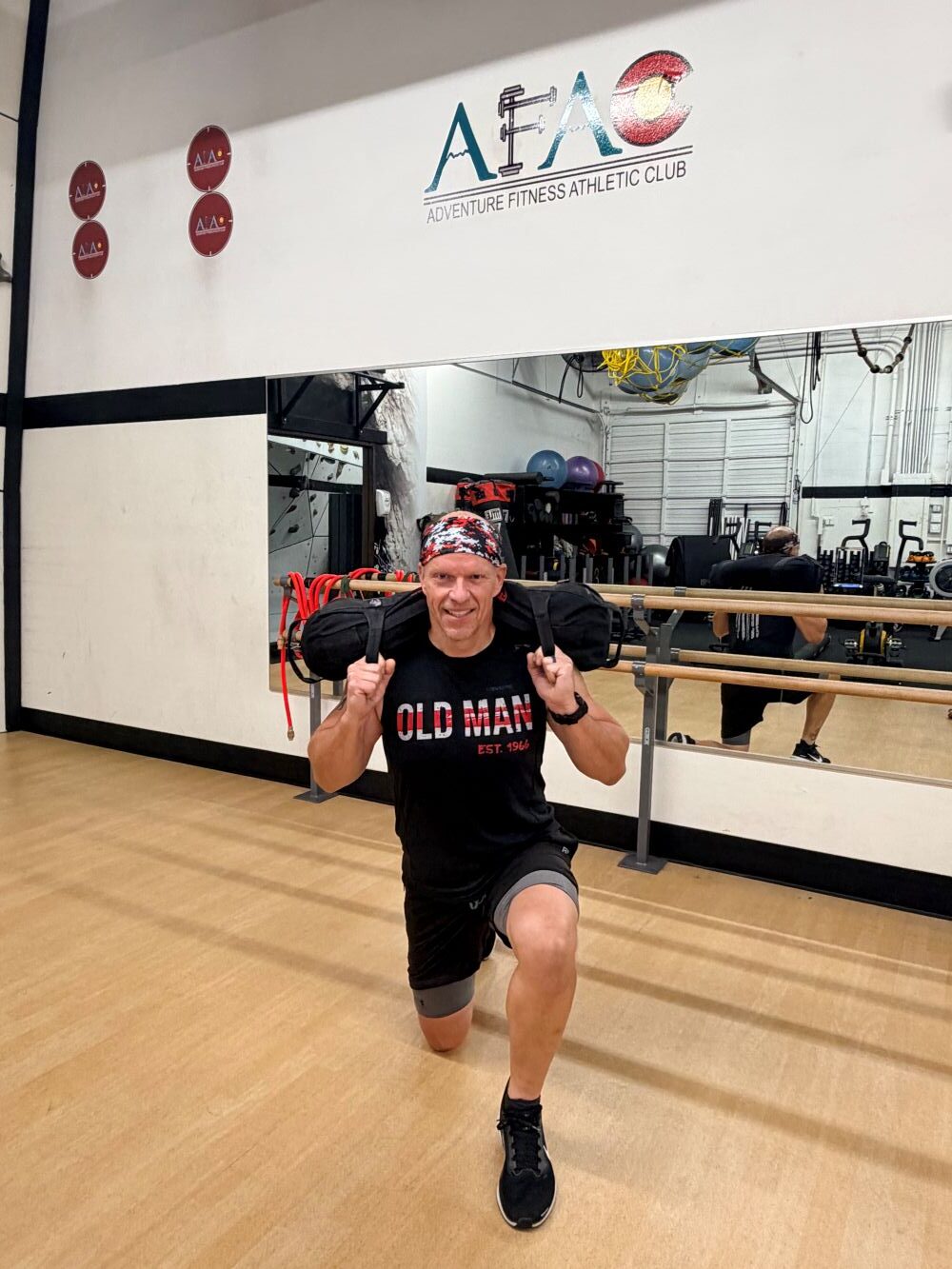
The seventh functional station challenges athletes to complete 100 meters of alternating walking lunges while carrying a sandbag across both shoulders. Success takes strength, endurance, balance, and a pace you can maintain when your legs are already working hard.
With The Feed HYROX Denver making its Mile High City debut November 12–15, 2026, this is an exciting time to prepare for the challenge. Several AFAC gym members will be competing, and we’re excited to help our community train with purpose.
As a HYROX-affiliated gym in Thornton, CO, AFAC offers specialized coaching, equipment, and classes to help you build the skills and conditioning this race demands. Here’s how to prepare for the station that can make tired legs feel even heavier.
Where Sandbag Lunges Fit into the HYROX Race
In a Singles race, you reach the sandbag lunges after completing seven kilometers of running and six functional stations:
- SkiErg
- Sled push
- Sled pull
- Burpee broad jumps
- Rowing
- Farmers carry
After the lunges, one final kilometer and the wall ball station stand between you and the finish. Doubles athletes follow the same sequence and both complete the running, while sharing the station work. Relay teammates divide the race’s running and stations.
That placement helps explain why lunges can become such a demanding part of the event. Your legs have already pushed sleds, powered broad jumps, and carried you through repeated runs. Now they must repeatedly lower and lift your body plus the sandbag.
The station is measured by distance rather than a fixed repetition count. Depending on your height and effective stride length, you might need roughly 85–130 lunges, although individual totals vary. Treat that range as a planning estimate, not a target. Your priority is covering the distance with consistent, legal repetitions.
Muscles Worked with Sandbag Lunges
Sandbag lunges place a substantial demand on your quadriceps and glutes. Your quads help control the descent and straighten your knee as you rise, while your glutes help extend your hip and bring you upright. The American Council on Exercise identifies both muscle groups as important contributors to the upward phase of a forward lunge.
Your hamstrings assist with hip control and stabilization, while the muscles around your hips, ankles, and feet help maintain balance as your weight shifts between legs.
The sandbag also gives your upper body a job. Your abdominal muscles and back muscles help support your torso, and your shoulders and arms help keep the bag secure.
Since it’s late in a HYROX race, coordinating all that work becomes more challenging. You may notice your steps shortening, your torso tipping forward, or your standing position becoming less complete. Practicing efficient movement gives you a familiar pattern to return to when fatigue builds, and helps preserve something for the final run.
HYROX Sandbag Lunges: Weights and Distances
The Singles, Doubles, and Relay divisions below all cover 100 meters. Your division determines the sandbag weight.
| Sandbag weight | Approximate pounds | Divisions |
| 10 kg | 22 lb | Women’s Open, Women’s Doubles, Women’s Relay, and female athletes performing lunges in Mixed Relay |
| 20 kg | 44 lb | Men’s Open, Women’s Pro, Men’s Doubles, Mixed Doubles, Women’s Pro Doubles, Men’s Relay, and male athletes performing lunges in Mixed Relay |
| 30 kg | 66 lb | Men’s Pro and Men’s Pro Doubles |
These weights follow the 2026/27 division standards. Adaptive categories have separate requirements.
When preparing for your event, learn what your assigned weight feels like across your shoulders. A bag that feels manageable for a few fresh repetitions can become a different challenge over a sustained distance.
How to Do HYROX Sandbag Lunges
Begin with bodyweight practice, then introduce a manageable sandbag once you can control the movement.
- Position the bag securely. Use a controlled pickup to place it evenly across both shoulders and your upper back. Keep it from pressing directly against your neck.
- Establish your posture. Stand tall, brace your midsection, and look ahead. Hold the bag securely without pulling your head forward.
- Step into a stable stance. Move one foot forward with enough width to maintain balance. Think of stepping along two parallel tracks rather than a tightrope.
- Lower under control. Bend both knees until your rear knee makes clear, controlled contact with the floor. Avoid dropping onto it.
- Rise through your front leg. Keep your front foot planted and extend your hip and knee until you are standing fully upright.
- Alternate legs. Bring the opposite leg forward for the next repetition.
- Maintain your rhythm. Keep breathing and use a stride you can repeat without wobbling, rushing, or losing your posture.
A coach can help you find a stride that suits your proportions. Reaching farther with every step may reduce your repetition count, but it offers little benefit if you struggle to stand up or maintain balance.
How to Train for HYROX Sandbag Lunges
Preparing for this station involves balancing strength, muscular endurance, aerobic fitness, and recovery. You need enough practice to make the movement familiar without letting lunge soreness disrupt the rest of your program.
Nail the Movement Standard Early
Practice the version you intend to use on race day. That means controlled knee contact, a complete standing position, alternating legs, and a secure shoulder position for the bag.
Ask a coach to watch several repetitions from the side and front. Small issues can be difficult to notice yourself, especially when you’re concentrating on keeping moving.
Learn the lane markings, too. Practicing starts and turns gives you an opportunity to make those details routine before the event.
Progress Volume Gradually
Start with a distance that allows you to maintain consistent technique. For some athletes, that might mean several short sets with a light bag. Others may already be ready for longer efforts at their division’s weight.
An illustrative progression could move from four 10-meter sets to four 15-meter sets, then three 20-meter sets. Longer continuous efforts can follow as your technique and recovery allow. This is a progression example, not a schedule everyone needs to follow.
Increase one challenge at a time. Adding weight, distance, and speed together makes it harder to judge what you can recover from.
Pay attention to your next workout. If lunge soreness substantially changes your running stride or prevents productive training for several days, review the dose with your coach.
Practice Sandbag Lunges Under Fatigue
First establish control while fresh. Then introduce selected workouts that place lunges after running or other station work.
For example, a coached session might include:
- A controlled 400-meter run
- A 10–20-meter sandbag lunge segment
- Another controlled 400-meter run
- Recovery before repeating, if appropriate
The goal is to practice the transitions and maintain movement quality. You don’t need to exhaust yourself before every lunge session.
Include the run afterward. Learning how to settle into running when your legs feel heavy is part of preparing for the race’s final kilometer.
Develop Your Aerobic Fitness
Your lunge performance also reflects how you paced everything that came before it. Arriving breathless and depleted can make a manageable bag feel much heavier.
Build your running consistently, with easier aerobic sessions alongside appropriately programmed harder efforts. Faster workouts should complement your strength and station training without turning every day into a maximal effort.
During combination sessions, experiment with a slightly more controlled approach to the preceding run. Assess the whole sequence: run, lunges, and run again. A faster first segment is less useful if it causes a major slowdown afterward.
Train Your Upper Body Position
Practice standing and moving with a sandbag across your shoulders. Short holds can help you become familiar with the position and learn to breathe while supporting the load.
Depending on your experience, supporting exercises may include:
- Goblet holds and carries
- Front-rack holds
- Zercher carries
- Farmers carries
- Trunk stability exercises
These movements challenge posture and load control in different ways. They support your preparation, but specific sandbag practice remains valuable.
Farmers carries also train grip endurance. However, remember that your shoulders support the sandbag’s weight during lunges; your hands primarily help keep it secure.
Build Tolerance Through a Comfortable Range of Motion
Your knees, hips, and ankles need repeated exposure to the positions used in lunging.
Controlled split squats, step-ups, and gradually deeper lunges can help you develop strength and control through the range you need. Heel-elevated squats may also be useful when they suit your mobility and training goals.
Isometric exercises offer another option. Wall sits and supported split-squat holds let you practice producing force without repeated movement. Coaches may also use brief pushes against a fixed resistance.
Choose exercises and depths that you can control comfortably. Persistent joint pain calls for an adjustment rather than simply adding more repetitions.
Training Tips and Strategy
Build Strength Alongside Muscular Endurance
Walking lunges provide specific practice, while split squats and Bulgarian split squats develop strength one leg at a time. Romanian deadlifts complement that work by training the glutes and hamstrings through a hip-hinge pattern.
Use these exercises within a balanced program. More lower-body work is only useful when you can recover and continue training effectively.
Keep Your Torso Supported
Aim for a tall, controlled torso with your ribs positioned over your pelvis. Avoid exaggerating the cue by arching your lower back or forcing your chest upward.
A small natural torso angle may occur, but progressive folding under the bag is a signal to reassess your pace, load, or fatigue.
Find Your Repeatable Stride
Shorter steps generally require more repetitions to cover the course, while longer steps change the balance and strength demands of each lunge. Neither is automatically the best choice.
Test your stride during training. Look for the combination of distance, control, and rhythm that lets you maintain proper depth and stand fully upright.
Use Pauses Deliberately
A brief standing pause may help you regain your breathing and posture before technique deteriorates. Continuous lunges can be quicker when you can sustain them cleanly.
Decide which approach works for you through practice. Avoid making your first pacing experiment during the race.
Plan for the Whole Finish
Think beyond completing the lunges. You still need to run and perform wall balls.
On the final run, establish a controlled rhythm before trying to accelerate. During training, notice which lunge pace leaves you able to move productively afterward.
Rules and Movement Standards for the HYROX Sandbag Lunge Station
The station includes collecting and returning your sandbag. Start upright with both feet behind the line, then begin by lunging across it.
Each repetition requires alternating legs, clear rear-knee contact, and full hip and knee extension at the top. Keep the bag supported across both shoulders. You may pause with your feet parallel, but additional walking steps or shuffling between repetitions are prohibited.
Your front foot must pass completely beyond each lane’s end line. You may walk around a turning point, then reset both feet behind the next working line and lunge across it. Finish with your leading foot fully beyond the final line and return the bag to its designated area.
Review your event briefing and the current rulebook before racing so you understand the course instructions.
Penalties for HYROX Sandbag Lunges
For movement-standard faults, the first infringement brings a formal warning; the second brings a 15-second penalty.
Other penalties include:
- Unloading the bag. Resting it on the ground, a barrier, your feet, or another surface to remove the load costs 15 seconds per occurrence.
- Incorrect return. Leaving the bag outside its designated area costs 30 seconds, unless you correct it before leaving the Roxzone.
- Wrong weight. You must repeat the entire station with the correct bag. Failing to do so results in disqualification.
Additional Doubles Rules
Doubles partners may share the 100 meters. Pass the bag sideways or backward during changes; forward passes are prohibited. The resting partner must follow behind the working athlete and avoid obstructing other competitors.
Practice exchanges together so both athletes understand the timing, direction, and hand placement.
Why Training Sandbag Lunges Makes You a Better Athlete
You don’t need a HYROX entry to benefit from sandbag lunges. Their combination of stepping, lowering, balancing, and standing under load makes them a useful challenge for a broader fitness program.
With appropriate progression, they can help develop:
- Lower-body strength. Your legs repeatedly control and move your body plus an external load.
- Single-leg control. Each step challenges your ability to manage your knee and hip position.
- Muscular endurance. Repeated efforts train your ability to sustain useful work.
- Postural endurance. Your trunk supports the bag while your legs move beneath it.
- Movement awareness. You learn to recognize changes in balance, depth, and extension as fatigue develops.
For HYROX athletes, these qualities come together in one demanding station. For other gym members, they offer another way to challenge strength, coordination, and conditioning.
Give Your Tired Legs a Game Plan at AFAC Gym
When you arrive at the sandbag lunges, you want a familiar movement, a practiced pace, and confidence in your preparation. Those qualities grow through consistent training, one controlled repetition and one purposeful session at a time.
At AFAC gym in Thornton, CO, our HYROX training classes, specialized coaching, and equipment can help you prepare for the demands of race day. With several AFAC members heading to HYROX Denver, there’s plenty of motivation to train alongside people working toward a shared challenge.
Whether you’re preparing for Denver or building your fitness for a future event, we’re here to help you take the next step.
If you’re not a member yet, we hope you’ll stop by AFAC gym today to speak to our team about our affordable memberships and personal trainers. AFAC gym is committed to supporting your health and wellness efforts, so you’ll see the results you’re working so hard for. That’s why we were voted the best gym in Thornton, Colorado, and have hundreds of 5-star reviews.
To learn more about our top-rated gym and our incredible array of strength training and cardio equipment — as well as our unique offerings and amenities like daily group classes, cryotherapy, InBody 770 assessments, hydro massage, personal trainers, and our rock climbing wall and cave — please contact us or visit for a personalized tour. Our team will be happy to help you. For more information and assistance, you can also contact our gym owner, Susan, at 720-849-0245 or susan@adventurefitness.club.