
Become a Believer in Box Jumps at AFAC Gym
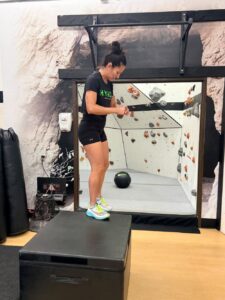
At Adventure Fitness Athletic Club in Thornton, Colorado, box jumps can also help members prepare for DEKA. The event’s third fitness zone involves traveling over a box, although competitors can choose a step-over instead of a jump-over. Learning to move confidently around a box gives you a foundation for either approach.
How to Perform Box Jumps at the Gym
Start with a stable box that lets you land securely. A higher box is useful only if you can reach it without pulling your knees excessively toward your chest or losing your balance.
- Set up. Face the box with your feet about hip-width apart. Leave enough room to swing your arms freely, and check that the box will not slide or tip.
- Get ready to jump. Soften your knees, move your hips back slightly, and brace your midsection. Keep your attention on landing with both feet fully supported by the box.
- Drive upward and land. Swing your arms and extend through your hips, knees, and ankles to propel yourself up. Land on both feet with bent knees, your weight balanced, and your knees tracking in line with your feet. Aim for a quiet landing that you can hold for a moment.
- Step down and reset. Stand securely, then step off one foot at a time. Take a breath and regain your starting position before the next repetition.
For power training, treat each jump as a separate effort. A controlled landing tells you more about the quality of the rep than the height printed on the box.
What Muscles Are Worked with Box Jumps?
Box jumps recruit several muscle groups in a coordinated movement:
- Quadriceps help straighten the knees during takeoff and control knee bend on landing.
- Glutes drive hip extension as you jump and help steady your hips when you land.
- Calves contribute to the final push through your ankles.
- Hamstrings assist the glutes and help control movement around the hips and knees.
- Core muscles help keep your trunk stable through takeoff and landing.
- Hip flexors and upper-body muscles help position your legs and coordinate the arm swing.
The exercise is more than a leg workout. Its challenge lies in getting these muscles to work together rapidly, then bringing your body to a stable stop on the box.
What Are the Benefits of Box Jumps?
- They train explosive power. Box jumps give you a chance to practice producing force quickly, a quality that matters when you jump, sprint, or accelerate into a new direction. Research on plyometric training has found improvements in measures such as jump performance and sprint ability, although results depend on the person and the training program.
- They develop landing control. A good rep ends with your feet planted and your body steady. Practicing that skill encourages you to pay attention to balance, knee position, and how you absorb force.
- They add variety to lower-body training. Squats and lunges build strength through controlled repetitions. Box jumps let you use that strength in a faster movement. They can fit alongside resistance training when power is one of your goals.
- Progress comes from consistent, controlled practice. Jumping onto the tallest box you can manage once is less useful than repeatedly landing well at an appropriate height.
What Height Should Beginners Use with Box Jumps?
A 12- to 18-inch box is one possible starting range for beginners, but the right height depends on your strength, mobility, and ability to land under control. Some people should begin lower or practice jumping and landing on the floor before using a box at all.
Start by testing a height where both feet land completely on top and you can pause without wobbling. If you have to round your back, pull your knees dramatically upward, or land in a very deep squat just to clear the edge, lower the box. Increase the height gradually only after your takeoff and landing are consistent. Experts emphasize building strength and landing control before progressing to more demanding plyometrics.
If jumping causes pain or you are returning from an injury, ask a qualified professional which movements are appropriate for you. Step-ups or controlled landing drills may be a better place to begin.
How Many Box Jumps Should You Do in One Training Session?
For a session focused on power, three to five sets of three to five jumps is a useful guideline. Rest enough between sets to make your next jump as controlled and energetic as your first. Placing jumps early in a workout, after warming up and before tiring leg exercises, can help you maintain that quality.
Stop the set if your landings become loud, uneven, or unsteady. Box jumps are poorly suited to training to failure: fatigue makes it harder to produce an effective jump and control the landing. Your ideal volume may be lower if you are new to jumping or are already doing other high-impact training that week.
Common Box Jump Mistakes
- Choosing a box that is too high. A dramatic knee tuck can make the box look reachable even when the jump itself is not very high. Choose a height that allows a balanced landing.
- Landing with stiff legs. Bend at the hips, knees, and ankles to absorb the landing instead of striking the box with straight knees.
- Letting the knees collapse inward. Keep them tracking generally in line with your feet as you land.
- Landing with only part of your feet on the box. Make sure the platform is large enough to support both feet securely.
- Jumping back down after every rep. Step down during ordinary box-jump practice to avoid adding an unnecessary landing from height.
- Rushing when tired. Rest or end the set when you can no longer land quietly and confidently.
Box Jumps for DEKA Athletes
DEKA challenges participants across 10 functional fitness zones. In DEKA STRONG, DEKA MILE, and DEKA FIT, Zone 3 calls for 20 box step-overs or jump-overs on a 24-inch box. DEKA FIT adds a 500-meter run or walk before each zone, so competitors arrive at the box with their breathing and heart rate already elevated.
A standard gym box jump ends on top of the box. A DEKA Zone 3 rep ends on the opposite side. Under the February 2026 DEKA rules, competitors may jump or step over; both feet must contact the top of the box during the rep, though they do not have to touch it at the same time. The rep counts once both feet reach the ground on the other side. You cannot clear the box without touching it or travel around its side.
That distinction matters when you train. Box jumps can help develop takeoff power and comfort landing on a raised surface. Step-overs help you practice balance, foot placement, and a sustainable rhythm across all 20 reps. Squats, lunges, and jump squats can support the leg strength and movement skills you use in the zone. As the event approaches, practice the actual over-the-box movement as well as your chosen supporting exercises.
AFAC gym offers DEKA/HYROX Performance classes for members preparing for functional fitness events. If DEKA is your goal, the classes and AFAC gym’s trainers can help you work on both the movement and the conditioning needed to complete it.
Do Box Jumps Count as Cardio or Strength Training?
Box jumps are primarily a power exercise. Each jump is a brief, forceful effort, so a power-focused session uses a small number of quality reps with recovery between sets. Your heart rate may rise, but that alone does not turn a few box jumps into a cardiovascular workout.
Repeated box movements in an event such as DEKA can feel very different. Moving over the box while fatigued tests endurance as well as coordination and leg strength. For event preparation, you may need to practice working at that pace. For general box-jump training, keep the focus on strong takeoffs and controlled landings instead of trying to make every set exhausting.
Box jumps also recruit the muscles of your lower body, but they should not be your only exercise if building leg muscle is the goal. Squats, deadlifts, lunges, and leg presses let you work those muscles under resistance through a greater range of motion. Pairing strength work with carefully planned jumps gives you ways to train both strength and power.
Take the Leap at AFAC Gym in Thornton
A great box jump is measured by the takeoff you create and the landing you control. Start at a manageable height, give each rep your attention, and build from there. Whether you want more explosive power or are preparing for DEKA Zone 3, AFAC gym can help you find a place for box work in your training.
If you’re not a member yet, we hope you’ll stop by AFAC gym today to speak to our team about our affordable memberships and personal trainers. AFAC gym is committed to supporting your health and wellness efforts, so you’ll see the results you’re working so hard for. That’s why we were voted the best gym in Thornton, Colorado, and have hundreds of 5-star reviews.
To learn more about our top-rated gym and our incredible array of strength training and cardio equipment — as well as our unique offerings and amenities like daily group classes, cryotherapy, InBody 770 assessments, hydro massage, personal trainers, and our rock climbing wall and cave — please contact us or visit for a personalized tour. Our team will be happy to help you. For more information and assistance, you can also contact our gym owner, Susan, at 720-849-0245 or susan@adventurefitness.club.